
Key takeaways
- In a meta-analysis of 15 longitudinal studies, obesity at baseline was associated with about 55% higher odds of later depression, and depression at baseline with about 58% higher odds of later obesity.
- Reported weight discrimination was associated with roughly 60% greater mortality risk even after adjusting for BMI itself, though most stigma research is cross-sectional.
- The MHRA concluded in September 2024 that available data do not support a causal link between GLP-1 medicines and psychiatric reactions, but the trials excluded people with significant psychiatric history.
- Several medicines used in mental health are associated with weight gain, and that is a conversation to have with your prescriber rather than a reason to stop taking them.
Two things are true at once, and neither is comfortable. People living with obesity are more likely to develop depression than people who are not. People with depression are more likely to develop obesity than people without it. The effect sizes are close to identical, which is the clue that this is a loop rather than a one-way street.
That matters practically. If you treat the weight and expect the mood to follow, you may be disappointed. If you treat the mood and expect the weight to follow, likewise. Most people need both looked at.
What the longitudinal data show
The most cited synthesis pooled 15 longitudinal studies covering 58,745 people [1]. Following participants forward:
- Obesity at baseline was associated with odds of later depression of 1.55 (95% CI 1.22 to 1.98)
- Depression at baseline was associated with odds of later obesity of 1.58 (1.33 to 1.87)
- Overweight but not obese at baseline sat lower, at 1.27 (1.07 to 1.51)
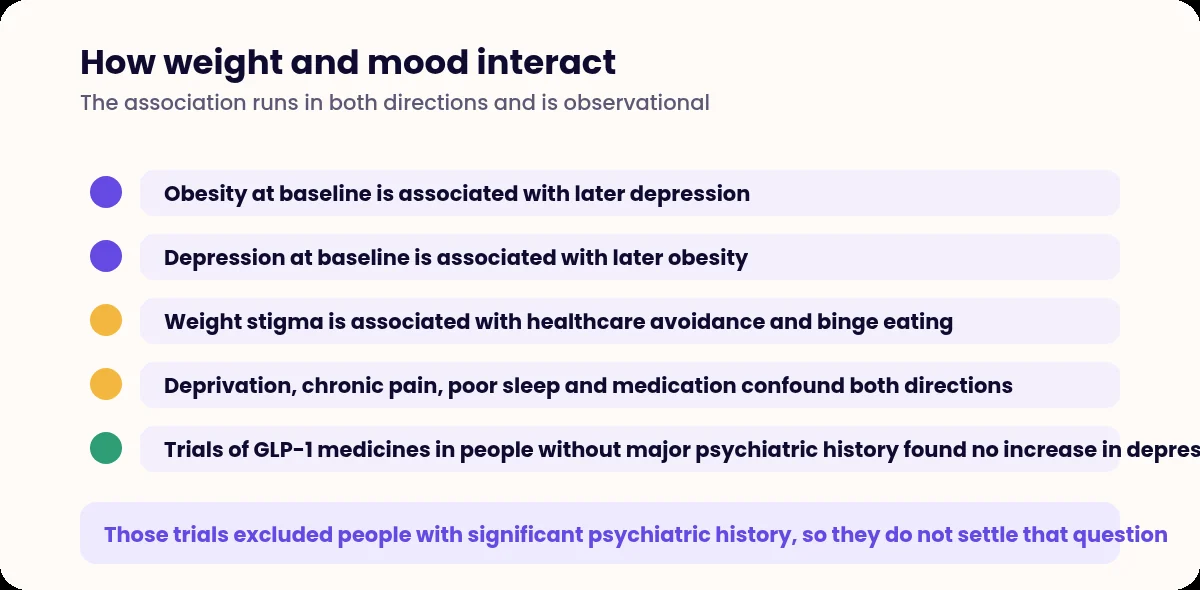
Read those carefully. They are odds ratios from observational cohorts, not effects measured in a trial. Nobody randomised anyone to gain weight. Confounding here is not a technicality: deprivation, chronic pain, disrupted sleep, reduced mobility and the side effects of psychiatric medicines all plausibly push both variables in the same direction. A share of that association almost certainly belongs to causes sitting behind both.
What the data do establish is that the association is real, it runs in both directions, and it strengthens with the degree of adiposity.
The mechanisms are not mysterious
Depression reduces activity, disrupts sleep, blunts motivation for planning and cooking, and for many people changes appetite. Several antidepressants and antipsychotics are independently associated with weight gain, covered in more detail in medicines that cause weight gain.
In the other direction, obesity is associated with chronic pain, obstructive sleep apnoea, reduced mobility and a low-grade inflammatory state, all of which have plausible links to mood. And then there is the social layer, which is the part clinical research has historically been worst at measuring.
Weight stigma is a health exposure, not a feeling
This is the finding that most surprises people. In a pooled analysis of more than 18,000 participants from two large US cohorts, reported experience of weight discrimination was associated with roughly 60% greater mortality risk [2]. Crucially, that association survived adjustment for BMI itself, along with subjective health, disease burden, depressive symptoms, smoking and physical activity.
In other words, the association was not simply a proxy for being heavier. Something about the experience of being treated badly tracked with dying sooner.
Be careful with how far that is pushed. It is a single pooled observational analysis, self-reported discrimination is measured crudely, and most of the wider stigma literature is cross-sectional. But the plausible pathways are well described: stigma is associated with avoiding healthcare, with increased binge eating, and with reduced physical activity. Each of those is a mechanism by which being treated badly produces worse health outcomes rather than better ones.
The intervention literature is sobering. Attempts to reduce weight stigma, in clinicians and in the public, have mostly shown null or short-lived effects. We know the exposure matters; we do not yet know how to remove it.
For an individual, the useful version of this is narrower: if you have been avoiding appointments because of how a previous one went, that avoidance is itself a health risk. Talking to your GP about weight covers how to make that conversation go better.
Eating as emotional regulation
Using food to manage feelings is ordinary human behaviour and does not need pathologising. It becomes a clinical question when there is loss of control, secrecy, distress afterwards, or compensatory behaviour such as purging or extreme restriction. That pattern points towards binge eating disorder or bulimia, and it needs assessment rather than a stricter diet. Calorie targets can make things worse in that situation.
Emotional eating goes into the distinction in more detail. If any of it sounds like you, say so before starting a weight loss programme, not after.
Weight loss medicines and mood
This has been the subject of a great deal of noise, so it is worth being precise.
Following reports of suicidal thoughts, the MHRA opened a review in July 2023 and concluded on 4 September 2024 that the available data do not support a causal association between GLP-1 receptor agonists and psychiatric reactions [4]. The review covered exenatide, lixisenatide, liraglutide, dulaglutide and semaglutide, and found no product information changes warranted. The European Medicines Agency reached a similar position in April 2024.
A post hoc analysis of trial data pointed the same way. Across the STEP trials in people without known major psychopathology, depressive symptom scores at week 68 were slightly lower on treatment than placebo, and reported suicidal ideation or behaviour was under 1% in both arms with no difference between them [3].
Here is the caveat that most coverage omits. Those trials excluded people with significant psychiatric history and active suicidality. So they are reassuring about the general treated population and genuinely uninformative about the group clinicians worry about most. UK summaries of product characteristics still advise monitoring for depression and suicidal thoughts in people with a relevant history, and that advice is not redundant.
Two practical points follow. First, if you have a mental health history, that belongs in the assessment, not left out of it. Second, privately prescribed weight loss medicines may not appear in your GP record, so tell any clinician treating your mental health that you are taking one. The class detail sits in weight loss medicine side effects.
What actually helps
Physical activity has reasonable evidence for mild to moderate depression independent of any weight change, which is one argument for judging activity by how you feel rather than by the scales. Sleep is worth treating as a primary target rather than an afterthought. And where mood is the dominant problem, treating it first is often what makes a weight change possible later.
Never stop a prescribed antidepressant or antipsychotic because of weight gain without discussing it with your prescriber. There are usually options within the class, and abrupt discontinuation carries its own risks.
When to seek help urgently
- Thoughts of harming yourself, or that life is not worth living — contact your GP the same day, call 111, or go to A&E if you feel unsafe now
- A marked deterioration in mood after starting any new medicine — contact your prescriber promptly
- Binge eating with loss of control, or purging behaviour — ask your GP for a referral rather than starting a diet
Frequently asked questions
Does being overweight cause depression?
The honest answer is that they travel together and the direction is not settled. Longitudinal data show obesity predicts later depression and depression predicts later obesity, with similar effect sizes. Both are also linked to deprivation, chronic pain, poor sleep and medication effects, any of which could be driving part of the association.
Why does losing weight not always improve my mood?
Because mood was rarely caused by weight alone. Some people feel markedly better; others find that the thing they expected to fix did not fix itself, which can be its own disappointment. If low mood persists or worsens during weight loss, that is worth raising with a clinician rather than waiting it out.
Do weight loss injections affect mood?
The MHRA reviewed this and concluded in September 2024 that the available data do not support a causal association between GLP-1 medicines and psychiatric reactions. A pooled analysis of trial data found slightly fewer depressive symptoms on treatment. However, those trials excluded people with significant psychiatric history, so they do not answer the question for that group.
Is emotional eating a mental health problem?
Not in itself. Using food to manage feelings is common and not a diagnosis. It becomes clinically relevant when it involves loss of control, distress, secrecy or compensatory behaviour, which points towards an eating disorder and needs assessment rather than a diet plan.
References
- Luppino FS, de Wit LM, Bouvy PF, et al. Overweight, obesity, and depression: a systematic review and meta-analysis of longitudinal studies. Archives of General Psychiatry. 2010;67(3):220-229. doi.org/10.1001/archgenpsychiatry.2010.2
- Sutin AR, Stephan Y, Terracciano A. Weight discrimination and risk of mortality. Psychological Science. 2015;26(11):1803-1811. doi.org/10.1177/0956797615601103
- Wadden TA, et al. Psychiatric safety of semaglutide for weight management: post hoc analysis of the STEP trials. JAMA Internal Medicine. 2024. doi.org/10.1001/jamainternmed.2024.4346
- MHRA. GLP-1 receptor agonists: review of suicidal thoughts and self-injury concluded. Drug Safety Update. 4 September 2024. www.gov.uk/drug-safety-update
- NHS. Depression in adults: symptoms and treatment. www.nhs.uk/mental-health/conditions/depression-in-adults/
Medical reviewer
Naeem Teni
Clinical Lead at Manova. Registered pharmacist and independent prescriber, GPhC 2215591. Reviews Manova’s clinical content for accuracy and safety.
Written by
Manova Editorial Team
Researched and written to our editorial policy, using NICE, NHS, MHRA and peer-reviewed sources.
This article is for general information and isn’t a substitute for advice from your own clinician. If you feel unwell, contact your GP or NHS 111. In an emergency, call 999.