

Key takeaways
- The Hamilton-Norwood scale grades male pattern hair loss from I to VII by the shape of the loss, with separate type A variants for straight-back recession without a crown patch.
- It is a morphological description, not a diagnostic test: it does not measure density or miniaturisation and does not predict how fast loss will progress.
- Female pattern hair loss is graded differently, on the Ludwig or increasingly the Sinclair scale, because the frontal hairline is usually preserved.
- Its real value is standardised documentation and before-and-after photography, which is also the most useful thing you can do at home.
If you have looked up hair loss online you have seen the row of seven heads. The Norwood scale is the standard way clinicians describe the shape of male pattern hair loss, and it is genuinely useful for that. It is also routinely asked to do three things it cannot do: diagnose, predict, and decide treatment.
Understanding what it is measuring makes it a much less frightening image.
Where it comes from
Hamilton published the original classification in 1951 after examining several hundred men; Norwood revised it in 1975 into the version still used today [1]. It is descriptive taxonomy, in the same spirit as grading any other visible change — someone looked at a lot of scalps and grouped the recurring shapes.
That origin matters. The scale was built to let two clinicians in different places describe the same head in the same words, and to let trials define who was eligible to enter. It was not built from follicle counts or from any biological measurement.
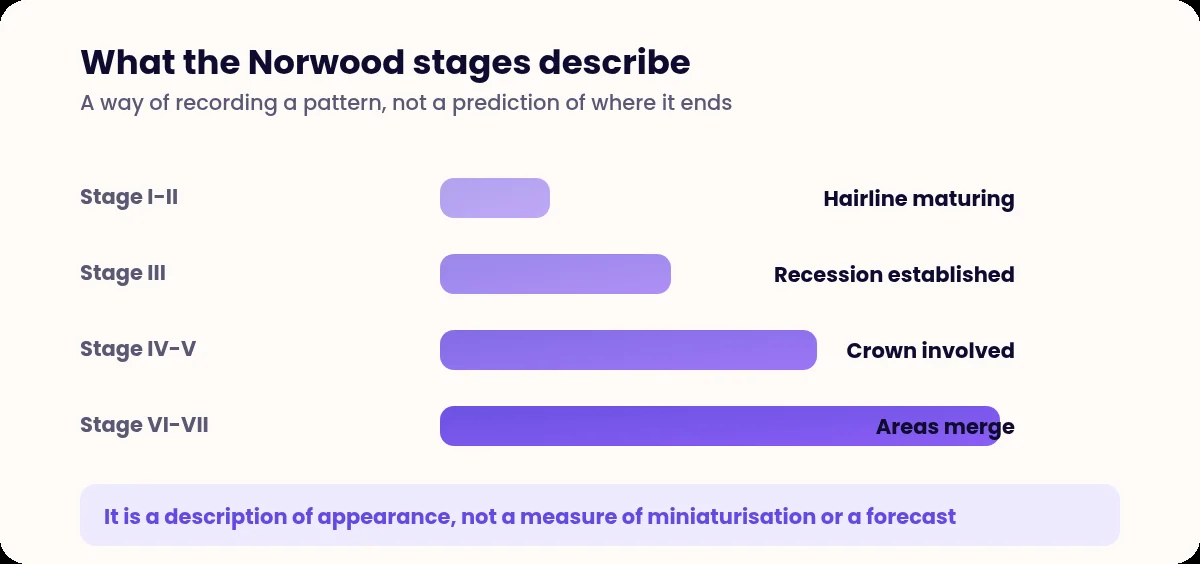
The seven stages
Type I is no recession or minimal recession — essentially the adolescent hairline still sitting low across the forehead.
Type II is symmetrical triangular recession at the temples. This is where the scale and real life get tangled, because the great majority of men develop some temporal recession in their twenties as the juvenile hairline matures, and that is not disease. Our guide to a receding versus a mature hairline covers how the two are told apart, which is by miniaturisation rather than by shape.
Type III is described by Norwood as the minimal level of loss that would be considered baldness. Type III vertex is a separate designation for loss that is predominantly at the crown, with the front still close to stage II.
Type IV shows further frontal recession together with an enlarged area of loss at the vertex, with a dense band of hair running across the top of the scalp separating the two.
Type V is the same arrangement with that separating band becoming narrower and sparser.
Type VI is the point at which the band disappears and the frontal and vertex areas become confluent — a single area of loss rather than two.
Type VII is the most advanced grade: a horseshoe of hair remaining around the sides and back, with the whole top of the scalp involved.
The type A variants
Grades IIA to VA describe a different route to the same place. In type A patterns the hairline recedes straight back across the front without a separate bald spot developing at the crown, so there is never a band of hair to lose [1]. The front simply advances backwards as one boundary.
This is worth knowing because type A patterns are sometimes mistaken for faster progression when they are really a different geometry. It also has practical consequences for anyone considering surgery, which is covered in our guide to hair transplants in the UK.
What the scale cannot tell you
This is the part that gets left out, and it is the part that matters most [1, 3].
It does not measure hair density. Two men graded IV can have very different amounts of hair within the same outline. The scale records the boundary, not what is inside it.
It does not measure miniaturisation. The process underlying pattern loss is follicles producing progressively finer hairs over successive cycles, which is discussed in male pattern baldness. That happens well before any outline changes, which is precisely why the scale is poor at capturing early disease.
It does not measure shedding. Someone can be shedding heavily and remain at the same grade for a year; someone can shed nothing noticeable and progress.
It does not predict progression. There is no prognostic information encoded in a grade. It cannot tell you whether you will reach stage VI, or when.
It does not determine treatment response. Grade is not a good guide to who will respond to medical treatment, although how much hair remains at the point of starting does bear on what there is left to keep.
Its reliability is only moderate. Agreement between different observers grading the same person is imperfect, and early grades are where the disagreement concentrates.
It was validated predominantly in white European populations. DermNet notes that up to around half of white men have some degree of loss by fifty and around 80% by seventy, with rates significantly lower in Japanese and Chinese populations [1]. A scale derived from one population does not transfer perfectly to another.
How women’s hair loss is graded
Female pattern hair loss follows a different distribution, so it needs a different scale [2].
The Ludwig scale (1977) has three grades: perceptible thinning over the crown with an intact frontal fringe; more pronounced thinning of the crown; and full loss of hair over the crown area. The defining feature across all three is that the frontal hairline is preserved — the fringe at the front stays, and the thinning happens behind it.
The Sinclair scale (2004) is a five-point scale based on the width of the central parting, from grade 1 as normal to grade 5 as advanced central thinning. It has largely displaced Ludwig in UK and Australasian practice because five points are more sensitive to change than three, and because a parting photograph is easy to reproduce at the same angle months later [2].
You will also see the “Christmas tree” pattern described, meaning accentuation of the parting towards the front. That is a separate observation and not part of the Ludwig grading. Our guide to female pattern hair loss goes through the assessment in full.
Diffuse loss in men and frontal loss in women both sit awkwardly on all of these scales, which is one reason clinicians treat grading as a starting point rather than a conclusion.
What to do with it instead
The scale earns its keep in three places: recording a baseline, entering someone into a trial, and communicating severity between clinicians in a single word.
The domestic equivalent of the first of those is the genuinely useful thing. Take photographs of the front, the crown from above and the parting, in the same light, at the same angle, with hair dry and unstyled. Repeat at six months and twelve months. That comparison answers the question people actually have — is this progressing, and how fast — which no single grade ever will.
If the loss is patchy rather than patterned, if the scalp is itchy, sore or scaly, or if the hairline is receding as a smooth band with the eyebrows thinning too, the scale is the wrong tool entirely. Those patterns point elsewhere, including to scarring alopecia, which needs assessing promptly because the follicle loss is permanent. Book a GP appointment within the week rather than monitoring it yourself.
Frequently asked questions
What Norwood stage am I?
Most people can place themselves roughly by comparing the outline of their hairline and crown to the stages, but self-grading is unreliable in early loss. Inter-observer agreement between clinicians is only moderate even with good photographs, and the scale is poor at capturing the earliest changes, which is where accuracy matters most.
Does a higher Norwood stage mean faster hair loss?
No. The scale records where you are now, not how quickly you got there or where you are heading. A man at stage III at forty-five may be stable, while a man at stage II at twenty-two may be progressing quickly. Rate of change can only be established by comparing images over time.
What is Norwood type A?
The type A variants, graded IIA to VA, describe a hairline that recedes straight back across the front without developing a separate bald patch at the crown. The front and the crown never form two distinct areas, so the front simply moves backwards as one line.
Is the Norwood scale used for women?
Rarely. Female pattern hair loss usually spares the frontal hairline and thins diffusely over the crown, which the Norwood stages describe badly. The Ludwig scale or the five-point Sinclair scale is used instead, with Sinclair now common in UK practice.
References
- DermNet. Male pattern hair loss. dermnetnz.org/topics/male-pattern-hair-loss
- DermNet. Female pattern hair loss. dermnetnz.org/topics/female-pattern-hair-loss
- NICE Clinical Knowledge Summaries. Alopecia, androgenetic – male. cks.nice.org.uk/topics/alopecia-androgenetic-male/
- NHS. Hair loss. www.nhs.uk/conditions/hair-loss/
- British Association of Dermatologists. Patient information leaflets. www.skinhealthinfo.org.uk/
Medical reviewer
Naeem Teni
Clinical Lead at Manova. Registered pharmacist and independent prescriber, GPhC 2215591. Reviews Manova’s clinical content for accuracy and safety.
Written by
Manova Editorial Team
Researched and written to our editorial policy, using NICE, NHS, MHRA and peer-reviewed sources.
This article is for general information and isn’t a substitute for advice from your own clinician. If you feel unwell, contact your GP or NHS 111. In an emergency, call 999.