

Key takeaways
- No topical finasteride product holds an MHRA licence in the UK; anything supplied here is an unlicensed special, a compounded preparation or an import.
- Topical application reduced serum DHT by about 34.5% against 55.6% for the oral tablet, so systemic effects are reduced but not removed.
- The pregnancy handling precautions still apply, with an additional transfer risk from skin contact with the treated scalp that has no oral equivalent.
- A 2026 pharmacovigilance study found adverse event reports of the same types occurring with topical use, which undercuts claims that it has no systemic side effects.
This page is medicine information rather than an advert. Finasteride in any form is a prescription only medicine in the UK [6], and whether it is suitable is a decision for a prescriber after an assessment.
Topical finasteride is usually presented as the same treatment without the drawbacks. The reasoning is intuitive — put the drug where the follicles are and keep it out of the bloodstream — and the published data show it is partly, but only partly, true.
What exists, and where
The product behind most of the evidence is P-3074, also known as ALM12845: a finasteride 0.25% spray solution developed by Polichem and licensed to Almirall. A marketing authorisation application was filed with the EMA in September 2019, and it reached market through national licences and partners — as Caretopic in Italy and parts of Western Europe, and as Finjuve in the Middle East and North Africa and in South Korea.
There is no MHRA-licensed topical finasteride product in the UK [5]. Everything prescribed here is one of three things: an unlicensed “special”, a compounded preparation, or an import.
That matters more than it sounds. A special is prepared to meet an individual patient’s needs where no licensed product is suitable. UK rules governing specials are tight and the MHRA regulates the manufacturers, but a special has not been through the assessment of quality, safety and efficacy that a licence represents, and the consistency you get from a licensed production line is not guaranteed in the same way. The US FDA issued warnings during 2025 about compounded topical finasteride products and adverse event reports associated with them, which is the same concern from a market where compounding is far less controlled.
One further point of accuracy, because it appears widely: a licensed finasteride and minoxidil combination topical is not available in the UK, and we have not been able to verify a licensed combination product in the EU either. Treat any claim that you are being supplied a licensed combination as something to check rather than accept.
What the absorption data show
The phase III programme included 458 participants and measured the thing everyone wants to know [1].
Peak plasma finasteride concentrations were more than 100 times lower with the topical spray than with the 1mg tablet. That is a genuinely dramatic reduction in exposure.
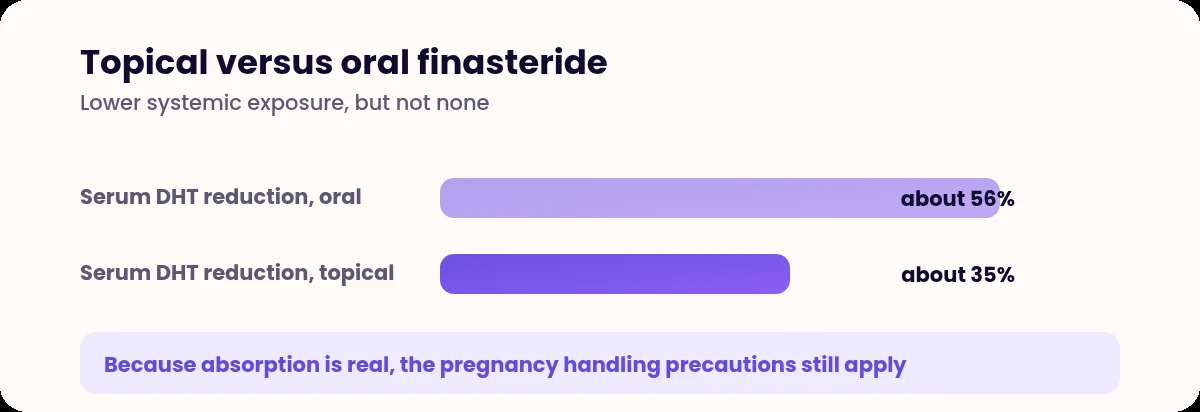
But mean serum DHT fell by 34.5% with the topical spray, against 55.6% with the oral tablet [1].
Those two figures sit together awkwardly, and the second is the one that matters clinically. Despite plasma drug levels two orders of magnitude lower, the topical route still produced roughly two-thirds of the oral effect on circulating DHT. The drug is absorbed; the DHT suppression it causes is systemic, not confined to the scalp.
The efficacy result was that the 0.25% spray was non-inferior to oral finasteride 1mg on target-area hair count and superior to vehicle [1].
Non-inferiority is a specific claim and worth reading carefully. It means the trial was designed to show the topical was not worse than the tablet by more than a pre-specified margin, over the trial’s duration, on that particular measure. It is not a demonstration that the two are identical, and it says nothing about how they compare over the years a treatment like this is actually taken.
What that means for side effects
If serum DHT is suppressed, the mechanism that produces the sexual and psychiatric effects associated with oral finasteride has not been switched off. It has been reduced.
A 2026 pharmacovigilance study in the International Journal of Dermatology examined whether topical finasteride’s safety profile genuinely differs from oral in adverse event reporting data [2]. The findings indicate that adverse event reports of the same types do occur with topical use. That does not establish a rate — spontaneous reporting databases have no denominator and cannot measure incidence — but it directly undercuts the marketing claim that topical finasteride is free of systemic side effects.
The honest framing is: lower systemic exposure, a plausible expectation of fewer systemic side effects, and no basis for saying there are none. The UK safety position set out in the May 2026 Drug Safety Update — that finasteride is associated with depression, suicidal ideation and sexual dysfunction which may persist after treatment is stopped [4] — is about the active substance, and a prescriber assessing anyone for a topical formulation should be having the same conversation. Finasteride side effects covers that in full.
There are also route-specific effects. Scalp irritation, itch and contact dermatitis are reported with topical preparations, and depend heavily on what the finasteride has been dissolved in — a familiar problem from minoxidil side effects, where the vehicle rather than the drug is usually the culprit. With a compounded preparation, the vehicle is not standardised between suppliers, so a reaction to one formulation does not necessarily predict a reaction to another, and nor does tolerance of one predict tolerance of the next.
Pregnancy precautions still apply
This is the point most likely to be got wrong, and the consequences are the most serious.
Oral finasteride is contraindicated in pregnancy and in women of childbearing potential because inhibiting the conversion of testosterone to DHT risks abnormalities of the external genitalia, specifically hypospadias, in a male foetus [3]. Because topical application produces measurable systemic absorption and about 34.5% serum DHT suppression, that theoretical risk is reduced but not eliminated.
The topical route then adds a hazard the tablet does not have. A coated tablet in a blister keeps the active ingredient away from anyone else’s skin. A solution sprayed onto a scalp does not. Transfer can occur by direct skin contact with the treated scalp, from hands, or via a pillowcase.
Practically: women who are or may become pregnant should not handle the product and should not contact the application site. Apply it yourself, wash your hands immediately, allow the scalp to dry fully before contact with anyone, and think about shared bedding. None of this is theoretical fuss; it is the reason the topical route needs more handling care than the tablet, not less.
How to think about it
Topical finasteride is a reasonable idea supported by a decent phase III trial, sold in the UK in a form that has not been licensed here, with a systemic effect its marketing frequently denies.
If it is being considered, the useful questions are what exactly is being supplied and by whom, what concentration and what vehicle, whether the supplier is properly regulated, and whether the prescriber has covered the same safety ground they would for the tablet. Finasteride explained sets out what the oral medicine does, and dutasteride for hair loss covers the other off-label direction people take when the standard option has not suited them.
Frequently asked questions
Is topical finasteride licensed in the UK?
No. There is no MHRA-licensed topical finasteride product. A 0.25% spray solution developed as P-3074 is marketed under national licences elsewhere, including as Caretopic in Italy and parts of Western Europe and as Finjuve in other markets. Anything supplied in the UK is an unlicensed special, a compounded preparation or an import.
Does topical finasteride avoid systemic side effects?
It reduces systemic exposure substantially but does not eliminate it. Peak plasma concentrations were more than 100 times lower than with the 1mg tablet, yet serum DHT still fell by around 34.5% compared with 55.6% for the tablet. That is roughly two-thirds of the oral effect on circulating DHT, which is a systemic effect by definition.
Can my partner touch my scalp if she might be pregnant?
Not where the product has been applied. Because absorption is real, the theoretical risk to a male foetus is not removed, and the topical route adds a transfer hazard the tablet does not have: direct skin contact with the treated scalp, via hands, or via a pillowcase. Women who are or may become pregnant should not handle the product or contact the application site.
What is an unlicensed special?
A medicine prepared or imported to meet the needs of an individual patient where no licensed product is suitable. UK rules on specials are tightly controlled and the MHRA oversees the manufacturers, but a special has not gone through the assessment of quality, safety and efficacy that a licence involves, and batch-to-batch consistency is not assured in the same way.
References
- Piraccini BM et al. Efficacy and safety of topical finasteride spray solution for male androgenetic alopecia: a phase III randomised controlled trial. JEADV, 2022. pubmed.ncbi.nlm.nih.gov/34634163/
- Gupta AK et al. Pharmacovigilance analysis of topical versus oral finasteride adverse event reports. International Journal of Dermatology, 2026. onlinelibrary.wiley.com/doi/10.1111/ijd.17957
- Summary of Product Characteristics: Propecia 1 mg film-coated tablets. Electronic Medicines Compendium. www.medicines.org.uk/emc/product/2194/smpc
- MHRA. Finasteride and dutasteride: updated safety warnings for psychiatric side effects and sexual dysfunction. Drug Safety Update, 11 May 2026. www.gov.uk/drug-safety-update/finasteride-and-dutasteride-updated-safe
- MHRA. The supply of unlicensed medicinal products (specials): guidance note 14. www.gov.uk/government/publications/supply-unlicensed-medicinal-product
- The Human Medicines Regulations 2012, regulation 284. www.legislation.gov.uk/uksi/2012/1916/regulation/284
Medical reviewer
Naeem Teni
Clinical Lead at Manova. Registered pharmacist and independent prescriber, GPhC 2215591. Reviews Manova’s clinical content for accuracy and safety.
Written by
Manova Editorial Team
Researched and written to our editorial policy, using NICE, NHS, MHRA and peer-reviewed sources.
This article is for general information and isn’t a substitute for advice from your own clinician. If you feel unwell, contact your GP or NHS 111. In an emergency, call 999.