
Key takeaways
- Chronic stress is associated with higher adiposity, particularly around the abdomen.
- Most of the effect runs through behaviour: sleep loss, eating patterns, reduced activity and alcohol.
- 'Adrenal fatigue' is not a recognised medical diagnosis, and cortisol tests sold direct to consumers have no validated role.
- Genuine cortisol excess is Cushing's syndrome, which is rare and has distinctive features.
There is a genuine relationship between chronic stress and body weight. There is also an entire commercial category built on a version of it that does not exist. Both are worth knowing about.
What is established
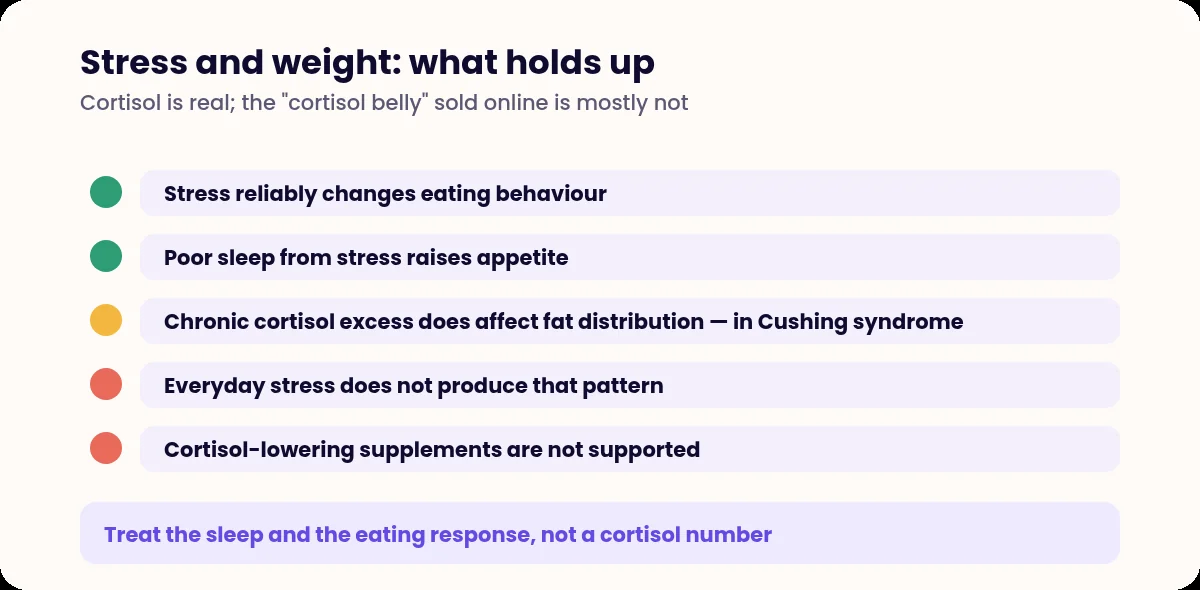
Chronic stress is associated with higher adiposity, particularly central adiposity, across multiple populations.
Cortisol is plausibly part of the mechanism. Sustained activation of the hypothalamic-pituitary-adrenal axis affects where fat is stored and how insulin behaves, and hair cortisol correlates with adiposity in some studies.
Most of the pathway is behavioural. Stress reliably reduces sleep, shifts eating towards energy-dense foods, reduces physical activity and increases alcohol intake. Each of those independently affects weight, and together they account for a great deal.
Individual variation is wide. Some people eat more under stress; a substantial minority eat less. Effect sizes across the literature are modest [4].
What is not established
“Cortisol belly.” Not a medical entity. Abdominal fat has many contributors — genetics, sex hormones, alcohol, sleep, total energy intake, age — and attributing a particular abdomen to cortisol is not something a clinician can do by looking.
“Adrenal fatigue.” No endocrine society recognises this diagnosis. The symptom list — tiredness, poor concentration, cravings, low mood, difficulty coping — is real and common, but it is non-specific, and the conditions that genuinely produce it are worth excluding properly: thyroid disease, anaemia, coeliac disease, sleep apnoea, depression, and rarely genuine adrenal insufficiency, which is a serious and treatable condition.
Direct-to-consumer cortisol testing. Saliva and hair cortisol tests sold for wellness purposes have no validated role in weight management. Cortisol varies enormously through the day and with acute stress including the test itself.
Cortisol-blocking supplements. No credible evidence of weight loss.
The condition that is real
Cushing’s syndrome is genuine cortisol excess. It is uncommon, and it looks distinctive rather than subtle [2]:
- Weight gain concentrated on the trunk, face and upper back, often with thin arms and legs
- Purple or red stretch marks, typically wider than 1 cm
- Easy bruising, thin skin, poor wound healing
- Proximal muscle weakness — difficulty rising from a chair or climbing stairs
- A round, flushed face
- High blood pressure, high blood glucose, osteoporosis
The most common cause in practice is prolonged steroid treatment rather than a tumour.
If several of those features apply, that is worth a GP appointment — and it is a different conversation from a wellness cortisol test.
What to actually do
The interventions that work here are the ones that address the behavioural pathway, and they are unglamorous.
Sleep. The strongest evidence in this area. Extending short sleep by about an hour reduced spontaneous calorie intake by 270 kcal a day in a randomised trial, without any dietary instruction [3].
Regular eating. Stress plus an empty stomach is what produces the evening that gets away from you. See emotional eating.
Activity. Reduces stress reactivity and improves sleep, independently of weight.
Alcohol. Commonly increases under stress, disrupts sleep, and adds energy.
Address the stressor where it is addressable. Sometimes it is not, and then the target is what you do around it rather than the stressor itself.
Get help for the mental health part if it is the main part. Talking therapies are available through NHS self-referral in England without going through a GP.
The honest summary
Stress affects weight, mostly through what it does to your sleep, your eating pattern and your activity. Those are all things you can act on. A cortisol test will not add anything useful, and the supplements are selling a mechanism rather than an effect.
When to speak to a clinician
Book an appointment if you:
- have several features of Cushing’s syndrome — central weight gain with wide purple stretch marks, easy bruising, proximal muscle weakness, a round flushed face
- have taken oral steroids for a prolonged period
- have persistent fatigue that has not been investigated
- have low mood, anxiety or hopelessness, or are struggling to cope
- are using alcohol or food as the main way of managing stress
If you are struggling to cope and need to talk to someone now, Samaritans can be reached free on 116 123 at any time.
Frequently asked questions
Does cortisol cause belly fat?
Chronic stress is associated with more central fat, and cortisol is part of the mechanism. But 'cortisol belly' as a specific diagnosable entity is not a medical concept, and the effect sizes in the research are modest with wide individual variation.
Is adrenal fatigue real?
No endocrine society recognises adrenal fatigue as a diagnosis. The symptoms attributed to it are real but non-specific, and they have other explanations worth investigating properly — including thyroid disease, anaemia, sleep apnoea, depression and, rarely, genuine adrenal insufficiency.
Should I get a cortisol test?
Salivary and hair cortisol tests sold direct to consumers have no validated role in weight management. If there is genuine clinical suspicion of Cushing's syndrome or adrenal insufficiency, testing is done differently and interpreted by a clinician.
Do cortisol-blocking supplements work?
There is no credible evidence that supplements marketed as cortisol blockers produce weight loss. The category exists because the story is appealing, not because the trials support it.
References
- NHS. Stress. www.nhs.uk/mental-health/feelings-symptoms-behaviours/feelings-and-sym
- NHS. Cushing's syndrome. www.nhs.uk/conditions/cushings-syndrome/
- Tasali E, Wroblewski K, Kahn E, Kilkus J, Schoeller DA. Effect of sleep extension on objectively assessed energy intake among adults with overweight in real-life settings. JAMA Internal Medicine. 2022;182(4):365-374. doi.org/10.1001/jamainternmed.2021.8098
- Tomiyama AJ. Stress and obesity. Current Obesity Reports. 2018. doi.org/10.1007/s13679-018-0306-y
Medical reviewer
Naeem Teni
Clinical Lead at Manova. Registered pharmacist and independent prescriber, GPhC 2215591. Reviews Manova’s clinical content for accuracy and safety.
Written by
Manova Editorial Team
Researched and written to our editorial policy, using NICE, NHS, MHRA and peer-reviewed sources.
This article is for general information and isn’t a substitute for advice from your own clinician. If you feel unwell, contact your GP or NHS 111. In an emergency, call 999.