

Key takeaways
- UK Regaine product information states that shedding on starting generally occurs two to six weeks after beginning treatment and subsides within a couple of weeks, and that users should stop and consult their doctor if it persists beyond two weeks.
- The licensed guidance is to judge minoxidil formally at one year and to expect stabilisation rather than regrowth from finasteride at three to six months.
- On stopping, finasteride's beneficial effects begin to reverse by six months and return to baseline by nine to twelve months; minoxidil-regrown hair may disappear three to four months after stopping.
- Standardised baseline photography before day one is the highest-value thing a patient can do, because lighting, wetness, parting and angle vary far more than twelve months of treatment effect does.
This page is medicine information rather than an advert. Finasteride is a prescription only medicine in the UK [7], and whether it is suitable is a decision for a prescriber after an assessment.
Most of what goes wrong in the first year of treating pattern hair loss is a timing problem. People judge too early, panic at the shedding, stop before the assessment point, or reach twelve months with nothing to compare against. This page takes the timelines from UK product information rather than from clinic messaging, because where the two disagree the label is the more defensible source.
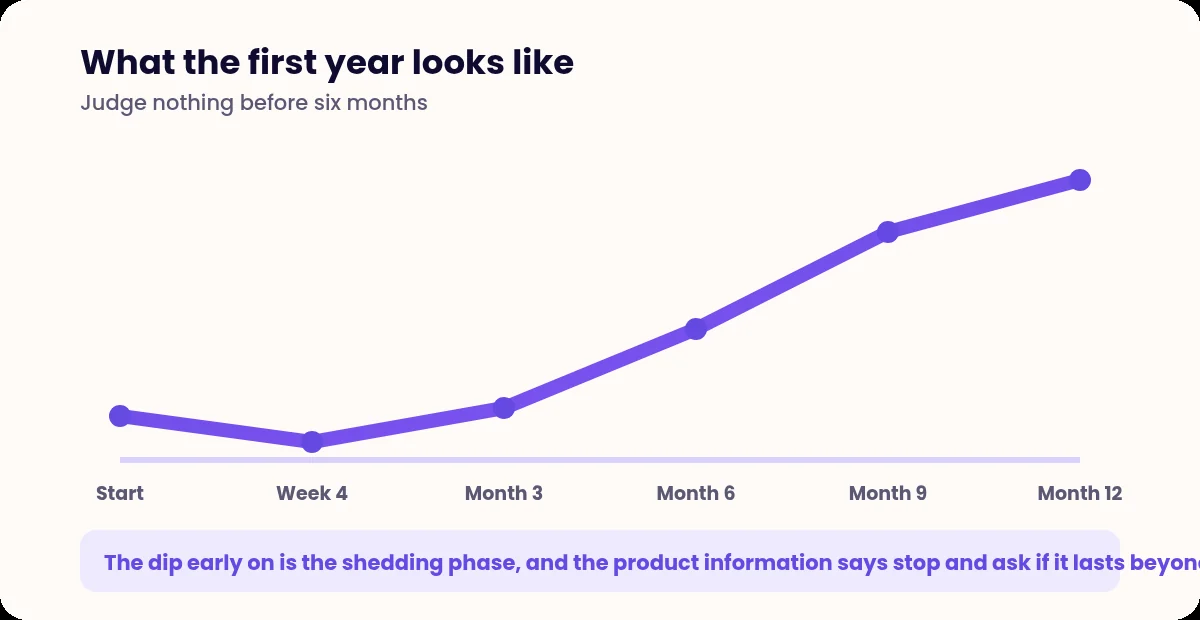
The shedding phase
UK Regaine product information is specific. Increased shedding on starting is “most likely due to minoxidil’s action of shifting hairs from the resting telogen phase to the growing anagen phase” [1]. It “generally occurs two to six weeks after beginning treatment and subsides within a couple of weeks” [1].
And then the sentence that almost never appears in online discussion: “if shedding persists (>2 weeks), users should stop… and consult their doctor” [1].
A genuine divergence worth naming
Clinics and online communities commonly tell people to push through a “dread shed” for two to three months, on the reasoning that it signals the treatment is working. The UK licensed advice is that if shedding persists beyond two weeks, stop and seek advice.
These are not compatible positions, and this page gives the label position because that is what has been assessed by a regulator. In practice the resolution is a conversation rather than a unilateral decision in either direction: persistent shedding is worth raising with your prescriber, who can consider whether something else is driving it — a telogen effluvium from an unrelated trigger is a common alternative explanation and needs a different response.
Finasteride does not have a characteristic shedding phase described in its product information [2].
When to judge results
The licensed timelines are clear and slower than most people expect.
Minoxidil: “it may take twice daily applications for two months or more before evidence of hair growth can be expected”, and “discontinue treatment if there is no improvement after one year” [1].
Finasteride 1mg: “generally, three to six months of once daily treatment are required before evidence of stabilisation of hair loss can be expected” [2].
Read that second one carefully, because the endpoint is stabilisation, not regrowth. The licensed claim is that hair loss stops getting worse. Some men also see thickening of miniaturised hairs, and that is a real effect, but it is not what the three-to-six-month statement is describing.
The practical framing that follows: judge nothing before month six, and make a formal assessment at twelve months. Anything in between is noise — season, lighting, how recently you had a haircut, whether your hair is wet.
What happens if you stop
Both product information documents address this directly, and the numbers matter because they define what kind of commitment this is.
Finasteride: beneficial effects begin to reverse by six months and return to baseline by nine to twelve months after stopping [2].
Minoxidil: regrown hair may disappear three to four months after stopping [1].
The honest framing of the first year is therefore: for most men it delivers arrest of progression plus partial thickening of miniaturised hairs. Follicles already lost to fibrosis do not return by any of these routes. Stopping returns the scalp to its untreated trajectory within nine to twelve months, including the ground gained. This is maintenance, not cure, and understanding that at the start prevents a particular kind of disappointment at year three.
Baseline photography: the highest-value thing you can do
This deserves more emphasis than it usually gets.
The registration trials that generated the licensed efficacy claims used global photographic assessment on a seven-point scale, with fixed camera-to-scalp distance, fixed head positioning, identical lighting and a consistent hair parting [1, 2]. Phototrichograms of a marked one-square-centimetre area gave hair count and diameter.
The reason that level of control exists is not fussiness. Bathroom-mirror and phone photographs vary with lighting, wetness, parting and angle far more than twelve months of treatment effect does. A treatment that is working will look like failure under a bright overhead bathroom light with wet hair, and a treatment doing nothing will look like success in soft light with dry, freshly cut hair.
So: take standardised baseline photographs before day one. Same room, same light source, same time of day, dry hair, same parting, same four angles — front, both sides, and crown from directly above. Then repeat at six and twelve months under identical conditions. Without a baseline the twelve-month decision is guesswork, and it is the one decision in this whole process that actually matters. Our guide to the Norwood scale gives a framework for describing what you are looking at.
Sticking with it
There is no good UK persistence dataset for hair loss treatment. Figures that circulate online — the widely repeated claim that half of people stop within a year, for instance — trace to small private-practice follow-ups and pharmacy claims studies in other health systems, not to UK cohorts. They should not be quoted as UK data, and this page will not quote one.
What is reported, qualitatively, as reasons for stopping: perceived lack of benefit before six months, cost, concern about side effects (particularly following the publicity around the 2024 and 2026 regulatory changes), and the realisation that treatment is indefinite. Three of those four are addressable by knowing the timelines at the start, which is the argument for reading a page like this before starting rather than in month four.
For the rate figures that are worth quoting, a systematic review of 41 studies published in Frontiers in Medicine on 18 June 2026 reported sexual adverse events with oral finasteride 1mg in men at 1.9 to 6.7%, against 0.9 to 3.9% on placebo across randomised trials; topical finasteride 0.25% at 2.8% against 4.8% for oral; and dutasteride 0.5mg at 4.1 to 12.0% against 4.0 to 5.0% for placebo, with no consistently reported sexual adverse effects in women [5]. Most reported events were transient and reversible.
The 2026 regulatory position
Anyone starting finasteride in the UK should know what the MHRA said on 11 May 2026 [3].
Finasteride is associated with depression, suicidal ideation and sexual dysfunction which may persist after treatment is stopped. Product information now also warns that sexual dysfunction may itself contribute to mood disorders. Patient alert cards, introduced in 2024, must be supplied with both 1mg and 5mg packs and read before taking the medicine. Prescribers are expected to review any history of depression or suicidal ideation before prescribing, to monitor, and to stop finasteride 1mg immediately if depression develops. Dutasteride carries a precautionary class warning [3].
Yellow Card data from 1994 to 31 May 2025 record 170 reports of suicidal ideation with finasteride, including 19 fatal suicides, and 5 reports with dutasteride [6]. These are spontaneous reports with no denominator and cannot be used to calculate incidence — they indicate the shape of a signal, not its frequency. Our page on finasteride side effects covers this in full, and minoxidil side effects covers the other component.
The General Pharmaceutical Council stated in October 2024 that “providing finasteride at a distance carries particular risk” [4]. Pharmacies supplying remotely are expected to risk assess the supply, verify medical history, set repeat-review intervals, and monitor for psychiatric and sexual side effects from initiation onwards. Our page on how online prescribing is regulated covers what that should look like from the patient’s side.
One UK-versus-US difference is worth flagging because so much online content is American. Finasteride 1mg is private prescription only in the UK and is not available on the NHS for hair loss. In the US it is routinely prescribed, direct-to-consumer telehealth supply is far less constrained, and there is no equivalent of the UK patient alert card requirement. Advice written for an American reader assumes a different regulatory environment throughout.
Frequently asked questions
How long does the shedding phase last?
UK Regaine product information states that increased shedding generally occurs two to six weeks after beginning treatment and subsides within a couple of weeks. It attributes the shedding to minoxidil shifting hairs from the resting telogen phase into the growing anagen phase. If shedding persists beyond two weeks, the label directs users to stop and consult their doctor.
Should I push through a dread shed for three months?
That advice is common online and it is not what the UK label says. The licensed product information directs users to stop and consult a doctor if shedding persists beyond two weeks. There is a genuine divergence here between clinic messaging and the regulated advice, and the label is the more defensible position. Raise persistent shedding with your prescriber rather than deciding either way alone.
When should I judge whether treatment is working?
Judge nothing before six months. Minoxidil product information states it may take twice-daily application for two months or more before evidence of growth, and directs discontinuation if there is no improvement after one year. Finasteride 1mg product information states that three to six months are generally required before evidence of stabilisation of hair loss — note that the endpoint is stabilisation, not regrowth.
What happens if I stop after a year?
Finasteride product information states that beneficial effects begin to reverse by six months and return to baseline by nine to twelve months. Minoxidil product information states that regrown hair may disappear three to four months after stopping. In both cases the scalp returns to its untreated trajectory, including the ground gained, which is why these treatments are described as maintenance rather than cure.
References
- Summary of Product Characteristics: Regaine for Men Extra Strength 5% w/v cutaneous solution. Electronic Medicines Compendium. www.medicines.org.uk/emc/
- Summary of Product Characteristics: finasteride 1 mg film-coated tablets. Electronic Medicines Compendium. www.medicines.org.uk/emc/
- MHRA. Finasteride and dutasteride: updated safety warnings for psychiatric side effects and sexual dysfunction. Drug Safety Update, 11 May 2026. www.gov.uk/drug-safety-update
- General Pharmaceutical Council. Statement on the supply of finasteride at a distance, October 2024. www.pharmacyregulation.org/
- Sexual adverse events with 5-alpha reductase inhibitors: a systematic review of 41 studies. Frontiers in Medicine, published 18 June 2026. www.frontiersin.org/journals/medicine
- MHRA. Yellow Card scheme: interactive Drug Analysis Profiles. yellowcard.mhra.gov.uk/
- The Human Medicines Regulations 2012, regulation 284. www.legislation.gov.uk/uksi/2012/1916/regulation/284
Medical reviewer
Naeem Teni
Clinical Lead at Manova. Registered pharmacist and independent prescriber, GPhC 2215591. Reviews Manova’s clinical content for accuracy and safety.
Written by
Manova Editorial Team
Researched and written to our editorial policy, using NICE, NHS, MHRA and peer-reviewed sources.
This article is for general information and isn’t a substitute for advice from your own clinician. If you feel unwell, contact your GP or NHS 111. In an emergency, call 999.