

Key takeaways
- Penile arteries are 1–2 mm across; coronary arteries are 3–4 mm. The smaller vessels show narrowing first.
- UK guidance describes ED as typically preceding cardiovascular events by 3–5 years.
- British Society for Sexual Medicine: a man with ED and no cardiac symptoms is a cardiac patient until proven otherwise.
- Every man presenting with ED should have glucose, lipids, blood pressure and testosterone checked.
This is the most clinically useful thing about erectile dysfunction, and the least discussed: it is frequently the first symptom of a process that will later present as a heart attack.
The anatomy argument
Atherosclerosis is a systemic process. It does not choose one artery.
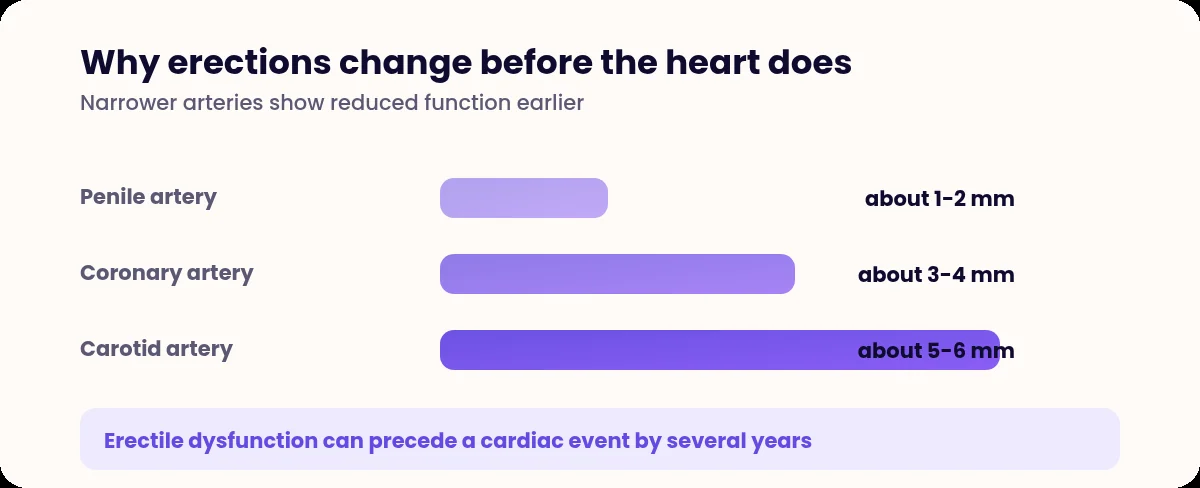
But it produces symptoms first wherever the margin is smallest, and that is a function of vessel diameter:
| Artery | Approximate diameter |
|---|---|
| Penile | 1–2 mm |
| Coronary | 3–4 mm |
| Carotid | 5–6 mm |
A given degree of narrowing reduces flow in a 1 mm artery long before it does in a 4 mm one. So the erection fails while the heart is still coping.
The interval
British Society for Sexual Medicine guidance describes erectile dysfunction as a sentinel marker for future cardiovascular events, typically occurring 3 to 5 years before an event, and notes it is particularly informative in men aged 40 to 49 [1].
Their headline statement is worth quoting directly:
A man with ED and no cardiac symptoms is a cardiac patient until proven otherwise. [1]
That figure comes from observational cohorts summarised in a guideline rather than from a randomised trial, so it is a reported typical interval rather than a prediction about any individual. But the direction is consistent and it is the basis of UK practice.
What should happen next
Not a prescription on its own. UK guidance recommends that every man presenting with erectile dysfunction has [1]:
- Fasting glucose and/or HbA1c
- Lipid profile
- Morning testosterone
- Blood pressure, heart rate and waist circumference
Together with an overall cardiovascular risk assessment. In the UK that is calculated using QRISK [3], which combines age, sex, ethnicity, blood pressure, cholesterol, smoking, diabetes, family history, BMI and other factors.
A note for anyone reading American material: US consensus guidance from 2024 recommends treating ED as a risk-enhancing factor and considering coronary artery calcium scoring. That is not UK practice, is not routinely NHS-commissioned for this indication, and UK risk assessment uses QRISK rather than the US equations.
Risk stratification and sex
Guidance uses a three-band approach [1]:
Low risk — controlled hypertension, asymptomatic with few risk factors, mild valve disease, successful revascularisation. Manage in primary care; sexual activity is fine.
Intermediate risk — further cardiac evaluation before reclassifying.
High risk — severe or unstable angina, uncontrolled hypertension, very recent heart attack. Defer both ED treatment and sexual activity pending cardiac assessment.
A practical threshold used in the product information for pharmacy-supplied ED medicines: if you become very breathless or get chest pain walking briskly for 20 minutes or climbing two flights of stairs, see a doctor before using them.
The reframe worth making
If you have gone to the trouble of seeking help for erectile difficulty, you have already done the hard part. The additional cost of a blood pressure reading, an HbA1c and a cholesterol test at the same appointment is close to zero, and it is the part that might matter most.
Treating the symptom without checking is a missed opportunity that is very easy to miss.
When to speak to a clinician
See a GP if you have:
- erectile difficulties lasting more than a few weeks, particularly with gradual onset
- ED alongside any chest discomfort, breathlessness on exertion, or pain in the calves when walking
- ED and have not had blood pressure, cholesterol or blood glucose checked in the last few years
- ED and a family history of early heart disease or stroke
- ED and diabetes, where assessment should be part of routine review
Seek emergency help for chest pain at rest, chest pain with sweating or nausea, or sudden severe breathlessness. Call 999.
Frequently asked questions
Is erectile dysfunction a sign of heart disease?
It can be an early one. Because the arteries supplying the penis are narrower than the coronary arteries, the same arterial disease produces erectile symptoms before it produces chest pain. UK guidance reports a typical interval of 3 to 5 years.
Does that mean I'm going to have a heart attack?
No. It means your cardiovascular risk should be assessed rather than assumed. Many men with ED have entirely normal cardiac assessments, and the point of looking is to find and treat risk factors early.
What should my GP check?
Blood pressure, heart rate, waist circumference, fasting glucose or HbA1c, a lipid profile and a morning testosterone. In the UK, overall risk is calculated using QRISK rather than a coronary calcium score.
Is it safe to have sex if I have heart disease?
For most people with stable, controlled cardiovascular disease, yes. The exercise demand is comparable to walking briskly or climbing two flights of stairs. If that level of exertion causes chest pain or severe breathlessness, get assessed before resuming.
References
- British Society for Sexual Medicine. Guidelines on the management of erectile dysfunction in men. 2018. bssm.org.uk/wp-content/uploads/2023/02/BSSM-ED-guidelines-2018-1.pdf
- NHS. Erectile dysfunction (impotence). www.nhs.uk/conditions/erection-problems-erectile-dysfunction/
- QRISK3 cardiovascular risk calculator. qrisk.org/
- NICE. Cardiovascular disease: risk assessment and reduction. CG181. www.nice.org.uk/guidance/cg181
Medical reviewer
Naeem Teni
Clinical Lead at Manova. Registered pharmacist and independent prescriber, GPhC 2215591. Reviews Manova’s clinical content for accuracy and safety.
Written by
Manova Editorial Team
Researched and written to our editorial policy, using NICE, NHS, MHRA and peer-reviewed sources.
This article is for general information and isn’t a substitute for advice from your own clinician. If you feel unwell, contact your GP or NHS 111. In an emergency, call 999.