

Key takeaways
- You are no more likely to have a stroke during sex than at any other time, and fear of recurrence is the commonest barrier rather than any physical limit.
- There is no fixed timeline for resuming sex after a stroke — the guide is physical and emotional readiness, discussed with your stroke team.
- UK practice is generally to avoid PDE5 inhibitors for about six months after a stroke and to review with the stroke team, because trials excluded men with a recent stroke.
- Medicines started after a stroke — some blood pressure drugs, antidepressants — commonly affect sexual function and are worth reviewing rather than enduring.
Sex is one of the least discussed parts of stroke recovery. It rarely comes up on the ward, it seldom appears in the discharge letter, and a great many couples go home with a question neither of them asks.
The reassurance first: you are no more likely to have a stroke during sex than at any other time. That is the Stroke Association’s position, and it is the answer to the fear that keeps most people from trying [1].
Blood pressure and heart rate do rise around orgasm. So do they climbing stairs, arguing, or carrying shopping. The absolute risk attached to sex specifically is very small, and fear of recurrence — not physical incapacity — is the commonest barrier clinicians see.
Timing, and the one thing that does have a timescale
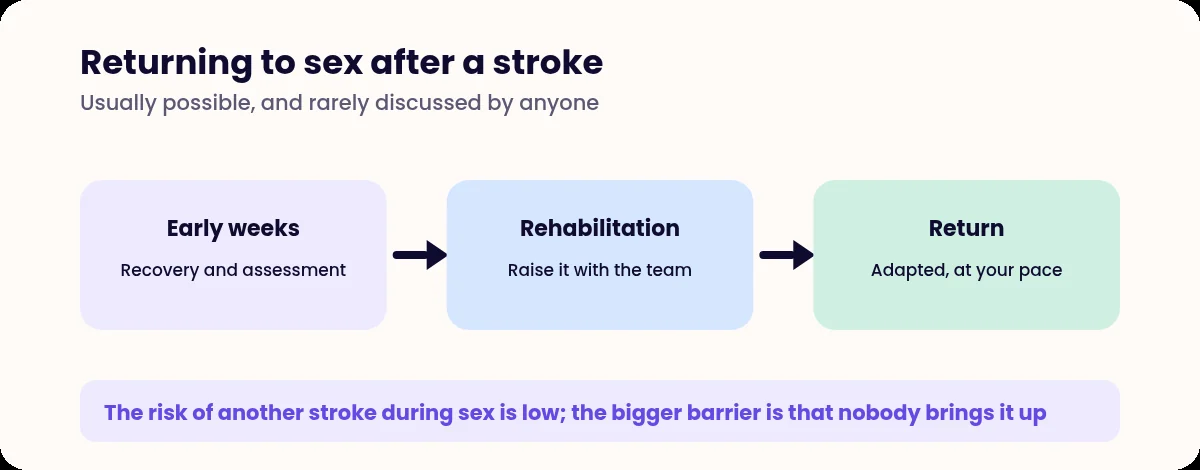
There is no fixed waiting period. The guidance is to resume when you feel physically and emotionally ready, which might be weeks for one person and many months for another. Neither is wrong.
Two situations warrant individual advice:
- Aneurysmal subarachnoid haemorrhage. Ask your neurosurgical or stroke team directly. Once the aneurysm has been secured, the risk should be minimal, but this is a question with a person-specific answer.
- Erection medication. The product licences for PDE5 inhibitors note that men who had a stroke within the previous six months were excluded from the trials. UK practice is generally to avoid PDE5 inhibitors for around six months after a stroke and to review the decision with the stroke team. This is a caution based on absent evidence rather than an absolute lifelong contraindication.
If PDE5 inhibitors are considered later, the nitrate and nicorandil check is critical in this group, because both are commonly prescribed after vascular events and both are absolutely contraindicated with the class. Our explainer on PDE5 inhibitors covers that.
What actually changes, and why
Changes after stroke come from three directions, and separating them makes the problem far more manageable.
Physical
Weakness on one side, spasticity, altered or lost sensation, poor balance, pain and fatigue all affect positioning and stamina. Erectile dysfunction is common after stroke, through a combination of vascular disease, neurological damage and medication. Continence concerns are frequent and are often the unspoken reason someone avoids intimacy altogether.
Practical adjustments do more here than anything else: choosing positions that put weight on the stronger side, using pillows for support, planning sex for the time of day when fatigue is lowest, and emptying the bladder beforehand.
Emotional and communicative
Low mood after stroke is common and reduces desire directly. Some strokes produce disinhibition or personality change, which can be distressing for a partner and is worth naming rather than tolerating in silence. Aphasia makes the negotiation of sex — initiating, declining, saying what feels good — much harder, and non-verbal signals and agreed gestures often become the workaround.
Role change
Where a partner has become a carer, the shift is one of the hardest parts of stroke recovery and rarely gets discussed. Couples who manage it well tend to be the ones who deliberately protect some time that is not care — and who talk about it explicitly. Our guide to talking to your partner applies directly here.
The medicines you went home on
Most people leave hospital after a stroke on several new medicines, and some of them affect sexual function:
- Thiazide diuretics and beta-blockers are the blood pressure medicines most consistently associated with erectile difficulty. Other classes are generally less implicated — see blood pressure medicines and erections.
- SSRIs, often prescribed for post-stroke mood, commonly reduce desire and delay or block orgasm.
- Statins are frequently blamed but the randomised evidence does not support it.
None of this is a reason to stop anything on your own. It is a reason to raise it at a review, because in most cases there is an alternative or a dose adjustment available.
Other neurological conditions, briefly
Multiple sclerosis. Sexual dysfunction is very common in men with MS, with erectile difficulty the commonest complaint; pooled prevalence estimates vary widely between studies, so a single headline figure is not worth quoting [3]. A useful model separates primary effects (direct demyelination causing erectile difficulty, reduced genital sensation, anorgasmia), secondary effects (fatigue, spasticity, bladder and bowel problems, pain) and tertiary effects (mood, body image, relationship). Managing the bladder before sex, timing activity around fatigue and treating spasticity often help more than anything aimed at the erection itself. MS is a condition that qualifies for NHS-funded erection treatment under the Selected List Scheme criteria. Help: MS nurse, neurology team, MS Society and MS Trust.
Parkinson’s disease. Erectile difficulty, reduced desire and ejaculatory problems are common, from autonomic dysfunction and from the condition itself. The two-way point matters: dopamine agonists can cause impulse control disorders including hypersexuality, a recognised MHRA safety concern that should be asked about directly and is often not volunteered. Orthostatic hypotension is common in Parkinson’s, so combining a PDE5 inhibitor with levodopa and antihypertensives needs lying and standing blood pressure checked first. Parkinson’s also qualifies under the SLS criteria. Help: Parkinson’s nurse specialist, Parkinson’s UK helpline 0808 800 0303 [6].
Spinal cord injury. Function depends on the level and completeness of the lesion. Reflexogenic erections are typically preserved where the sacral segments S2 to S4 are intact; psychogenic erections may be preserved in low lesions. Ejaculation and orgasm are affected far more than erection. PDE5 inhibitors work particularly well in this group and spinal cord injury qualifies under the SLS criteria. Fertility is usually limited by ejaculatory failure rather than sperm production, and specialist centres use penile vibratory stimulation and electroejaculation. Autonomic dysreflexia — a medical emergency triggered by sexual activity, ejaculation or vibratory stimulation in lesions at T6 and above — must be part of the conversation: pounding headache, flushing and a surging blood pressure need immediate action. Help: your SCI centre, Spinal Injuries Association helpline 0800 980 0501 [5].
Where to get help
Start with your GP or stroke specialist nurse. Neither will be surprised by the question, and both can review medication and arrange referral. The Stroke Association Helpline is 0303 3033 100 [1, 2].
For the psychological and relationship side, COSRT-accredited psychosexual therapists can be found directly [7], and Relate offers couple counselling. NHS psychosexual therapy is only patchily commissioned in the UK, so most access is private — worth knowing before you spend months on a waiting list that may not exist in your area.
If erectile dysfunction is the main issue and you are past the early recovery period, our guide to what causes erectile dysfunction covers the assessment that should happen alongside any treatment.
Frequently asked questions
Is it safe to have sex after a stroke?
For almost everyone, yes. The Stroke Association states plainly that you are no more likely to have a stroke during sex than at any other time. Blood pressure does rise around orgasm, but the absolute risk is very small. If your stroke was caused by a bleed from an aneurysm, ask for individual advice, though the risk should be minimal once the aneurysm is secured.
How long should I wait before having sex again?
There is no fixed period. The guidance is to resume when you are physically and emotionally ready, which varies enormously. What does have a timescale is erection medication: UK practice is generally to avoid PDE5 inhibitors for around six months after a stroke and to review the decision with the stroke team.
Could my new tablets be causing the problem?
Quite possibly. Thiazide diuretics and beta-blockers are the blood pressure medicines most associated with erectile difficulty, and SSRIs commonly affect desire, erection and orgasm. Most people leave hospital on several new medicines at once. Raise it with your GP or stroke nurse — there are usually alternatives, and stopping anything yourself is not the route.
Where can I get help in the UK?
Start with your GP or stroke specialist nurse. The Stroke Association Helpline is 0303 3033 100. For the relationship and psychological side, COSRT-accredited psychosexual therapists can be found directly, and Relate offers couple counselling. NHS psychosexual services exist but are patchily commissioned.
References
- Stroke Association. Sex and relationships after stroke. www.stroke.org.uk/stroke/life-after/sex-and-relationships
- Stroke Association. Sex and intimate relationships after stroke (full guide). www.stroke.org.uk/sex_and_intimate_relationships_after_stroke_guide.pd
- Sexual dysfunction in multiple sclerosis: systematic review and meta-analysis, 2022. pubmed.ncbi.nlm.nih.gov/35963537/
- European Association of Urology. Guidelines on Sexual and Reproductive Health. uroweb.org/guidelines/sexual-and-reproductive-health
- Spinal Injuries Association. Advice and support. spinal.co.uk/
- Parkinson's UK. Sex and relationships. www.parkinsons.org.uk/
- College of Sexual and Relationship Therapists. Find a therapist. www.cosrt.org.uk/
Medical reviewer
Naeem Teni
Clinical Lead at Manova. Registered pharmacist and independent prescriber, GPhC 2215591. Reviews Manova’s clinical content for accuracy and safety.
Written by
Manova Editorial Team
Researched and written to our editorial policy, using NICE, NHS, MHRA and peer-reviewed sources.
This article is for general information and isn’t a substitute for advice from your own clinician. If you feel unwell, contact your GP or NHS 111. In an emergency, call 999.