

Key takeaways
- NICE says offer referral at BMI 40, or 35 with a significant health condition, with thresholds 2.5 kg/m² lower for several ethnic groups.
- NICE explicitly rejected requiring people to complete specialist weight management first, calling it an unjustified barrier.
- Real-world total weight loss at three years: about 28% for gastric bypass and 22% for sleeve gastrectomy.
- Pooled perioperative mortality is about 0.08%, roughly 1 in 1,250.
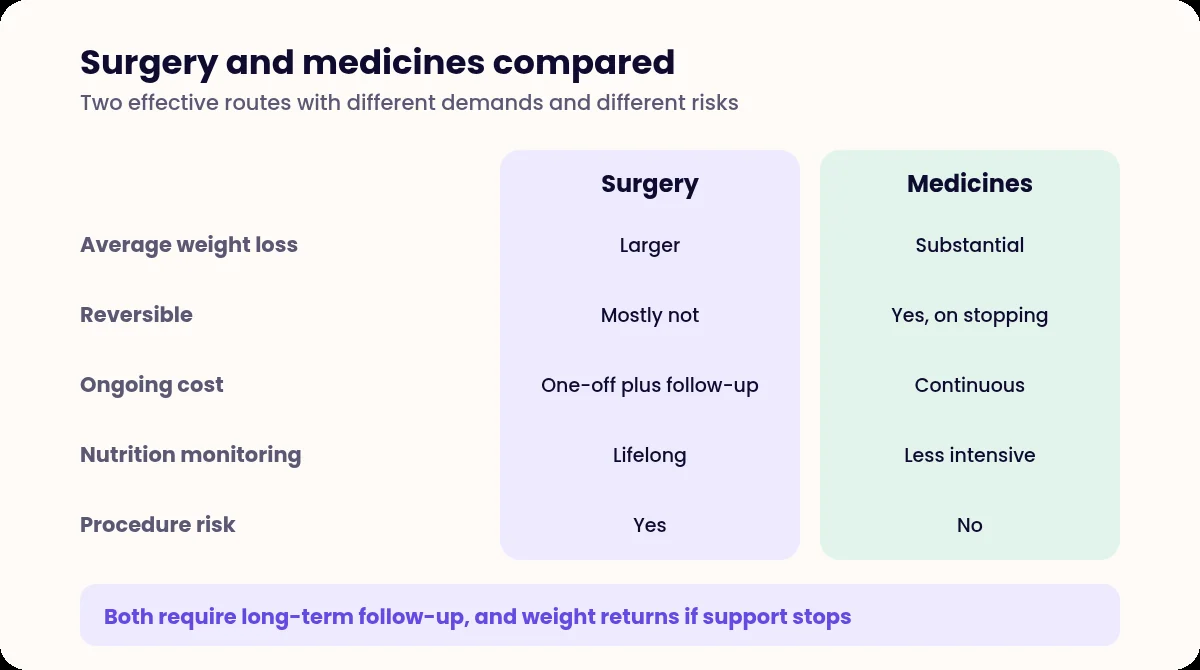
Bariatric surgery produces larger and more durable weight loss than anything else available. It is also the option people are most often told they do not qualify for, on the basis of a rule that NICE does not actually contain.
Who NICE says should be referred
From NG246 [1]:
| Situation | What NICE says |
|---|---|
| BMI 40 or above | Offer referral for comprehensive specialist assessment |
| BMI 35–39.9 with a significant health condition that could improve with weight loss | Offer referral |
| BMI 35 or above with type 2 diabetes diagnosed in the past 10 years | Offer expedited assessment |
| BMI 30–34.9 with type 2 diabetes diagnosed in the past 10 years | Consider expedited assessment |
All thresholds are lowered by 2.5 kg/m² for people of South Asian, Chinese, other Asian, Middle Eastern, Black African or African-Caribbean background.
“Significant health conditions” named by NICE include cardiovascular disease, hypertension, idiopathic intracranial hypertension, fatty liver disease, obstructive sleep apnoea and type 2 diabetes.
Referral is conditional on agreeing to the long-term follow-up that surgery requires — including lifelong annual review.
The myth worth correcting
The most repeated claim in this area is that you must complete a tier 3 or specialist weight management programme for six to twenty-four months before you can be referred for surgery.
NICE explicitly rejected this. The guideline committee stated that requiring people to try specific measures before referral “would create an unjustified barrier to effective treatment, and the evidence did not support using surgery only as a last resort.” They also noted that specialist services were commissioned by only around 21% of CCGs in England at the time of review, so mandating prior use would worsen health inequalities [1].
Local integrated care boards may still impose such requirements. That is a commissioning restriction, not clinical guidance, and it is worth knowing the difference when you are being told no — it is a decision about money, and it can be queried.
What the procedures achieve
A real-world analysis of 44,025 adults across two health systems, using inverse probability weighting to compare like with like, gives the cleanest modern comparison of total weight loss [2]:
| Treatment | 1 year | 3 years |
|---|---|---|
| Gastric bypass | 29.8% | 28.4% |
| Sleeve gastrectomy | 24.4% | 22.0% |
| Tirzepatide | 9.1% | — |
| Semaglutide | 5.4% | 7.4% |
Two things stand out. Surgery produces roughly two and a half to five times as much weight loss. And surgery’s figures are sustained at three years, whereas the medication figures are dragged down in the real world by people stopping.
Diabetes
The STAMPEDE trial followed people with type 2 diabetes for five years. HbA1c of 6.0% or below was achieved by 29% after gastric bypass, 23% after sleeve gastrectomy and 5% with medical therapy alone [4]. Over 88% of surgical patients maintained glycaemic control without insulin.
The risks, honestly
Pooled perioperative mortality across 58 studies and 3.65 million patients was 0.08% — roughly 1 in 1,250 [3]. By procedure:
- Gastric band 0.03%
- Sleeve gastrectomy 0.05%
- Gastric bypass and one-anastomosis bypass 0.09%
- Duodenal switch 0.41%
For context, that overall figure is in the same range as other common elective operations.
The longer-term considerations matter more for most people: lifelong vitamin and mineral supplementation and monitoring, the need to eat differently and permanently, dumping syndrome after bypass, gallstones, a raised risk of problems with alcohol, and the possibility of weight regain over years.
Surgery is not a procedure that removes the need for the rest of it. It changes the difficulty of the rest of it.
Access in practice
Provision is far below eligibility, and it varies enormously by area. A 2025 mapping across all 42 English integrated care systems found substantial variation in what is commissioned. Waits of years are common in many places.
That is a system problem rather than a reflection of whether you qualify, and it is worth asking specifically what your ICB commissions.
When to speak to a clinician
Raise surgery with your GP if you:
- have a BMI of 40 or above, or 35 or above with a related health condition
- have a BMI of 35 or above with type 2 diabetes diagnosed in the last 10 years, where expedited assessment applies
- are of South Asian, Chinese, Black African or African-Caribbean background and are near a threshold, where it drops by 2.5
- have been told you must complete a programme first and want to know whether that is a local rule
- have already had surgery and are regaining weight, which needs specialist input rather than starting again alone
Frequently asked questions
What are the criteria for weight loss surgery in the UK?
NICE says offer referral for specialist assessment at a BMI of 40 or above, or 35 to 39.9 with a significant health condition that could improve with weight loss, provided the person agrees to long-term follow-up. Expedited assessment is offered at BMI 35 or above with type 2 diabetes diagnosed in the last 10 years.
Do I have to complete a tier 3 programme first?
Not according to NICE. The guideline committee explicitly rejected requiring people to try specific measures before referral, describing it as an unjustified barrier that the evidence did not support. Some local commissioners still impose it, but that is a funding restriction, not clinical guidance.
How much weight do you lose?
In a large real-world comparison, gastric bypass produced about 28% total weight loss at three years and sleeve gastrectomy about 22%. That is roughly two and a half to five times what semaglutide or tirzepatide achieved in the same analysis.
How risky is it?
Pooled perioperative mortality across 58 studies and 3.65 million patients was 0.08%, around 1 in 1,250 — comparable to other common elective operations. Gastric band and sleeve are at the lower end; duodenal switch is considerably higher.
References
- NICE. Overweight and obesity management. NG246. January 2025. www.nice.org.uk/guidance/ng246/chapter/Medicines-and-surgery
- Comparative effectiveness of bariatric surgery and GLP-1 based medicines: real-world cohort of 44,025 adults. Obesity. 2026. pubmed.ncbi.nlm.nih.gov/42345739/
- Perioperative mortality following bariatric surgery: systematic review and meta-analysis of 58 studies. British Journal of Surgery. 2021;108(8):892-897. doi.org/10.1093/bjs/znab245
- Schauer PR, Bhatt DL, Kirwan JP, et al. Bariatric surgery versus intensive medical therapy for diabetes — 5-year outcomes (STAMPEDE). New England Journal of Medicine. 2017;376(7):641-651. doi.org/10.1056/NEJMoa1600869
- NHS. Weight loss surgery. www.nhs.uk/conditions/weight-loss-surgery/
Medical reviewer
Naeem Teni
Clinical Lead at Manova. Registered pharmacist and independent prescriber, GPhC 2215591. Reviews Manova’s clinical content for accuracy and safety.
Written by
Manova Editorial Team
Researched and written to our editorial policy, using NICE, NHS, MHRA and peer-reviewed sources.
This article is for general information and isn’t a substitute for advice from your own clinician. If you feel unwell, contact your GP or NHS 111. In an emergency, call 999.